The Essential Guide to Answer Engine Optimization and Selecting the Right AEO Checker for Your Brand

The fundamental nature of search is undergoing its most significant transformation since the inception of the World Wide Web. For decades, the digital landscape was defined by the "blue link" paradigm, where search engines acted as directories, directing users to external websites to find answers. Today, that model is being superseded by generative AI, which synthesizes information from across the internet to provide direct, conversational answers. This shift has birthed a new discipline: Answer Engine Optimization (AEO). As users increasingly rely on ChatGPT, Perplexity, and Google’s AI Overviews (AIO) to solve problems without clicking through to a host site, businesses must pivot their strategies to ensure their brands remain visible within the AI-generated response itself.
AEO is the practice of positioning a brand as a trusted, verifiable authority that AI models choose to cite. Unlike traditional Search Engine Optimization (SEO), which focuses on achieving a high ranking in a list of URLs, AEO is concerned with the content of the answer box. It is about becoming the source of truth that powers the AI’s synthesis.
![AEO checker tools that measure answer engine visibility [2026]](https://53.fs1.hubspotusercontent-na1.net/hubfs/53/aeo-checker-1-20260903-3858273.webp)
The Shift in Search Behavior: A Chronology
The move toward generative search did not happen overnight. For years, Google experimented with "Featured Snippets" to provide quick answers to user queries. However, the true inflection point occurred in November 2022, with the public release of ChatGPT. By demonstrating the utility of a conversational, synthesized response, OpenAI effectively changed consumer expectations.
Following this, the industry saw a rapid acceleration:
- May 2023: Google announces the Search Generative Experience (SGE), marking its formal entry into the generative AI race.
- December 2023: Perplexity AI gains significant market traction by positioning itself specifically as an "answer engine," prioritizing citations and sources over mere links.
- May 2024: Google officially launches AI Overviews (AIO) to the general public, embedding generative summaries into the standard search experience for millions of users.
- June 2026: Google introduces dedicated generative AI performance reporting, signaling a formal shift in how businesses are expected to track their presence in AI-driven results.
This timeline reflects a broader, irreversible transition. The search engine is no longer just a navigator; it is now an interpreter.
![AEO checker tools that measure answer engine visibility [2026]](https://no-cache.hubspot.com/cta/default/53/9dd5e54b-fbef-4dd0-bc44-1689feb1ea18.png)
Understanding the AEO Checker
As the reliance on answer engines grows, the need for specialized measurement tools has become critical. An AEO checker is a software solution designed to monitor whether a brand is being cited, mentioned, or ignored by AI models. Without such a tool, a business remains effectively blind to the "zero-click" ecosystem.
A high-quality AEO checker performs several diagnostic functions. It identifies which queries trigger AI-generated responses, evaluates the sentiment and accuracy of the brand’s mention, and benchmarks the brand’s performance against competitors. More importantly, these tools provide actionable insights, such as identifying content gaps where a competitor’s site is being cited while yours is overlooked.
Manual Verification versus Automated Scaling
While businesses can perform manual AEO checks, these are rarely sustainable at scale. A manual check involves using an incognito browser to input queries, observing the AI response, and recording the presence of brand mentions or citations.
![AEO checker tools that measure answer engine visibility [2026]](https://53.fs1.hubspotusercontent-na1.net/hubfs/53/aeo-checker-2-20260903-852936.webp)
The primary challenge with manual checking is the volatility of AI results. Unlike traditional search rankings, which remain relatively stable over short periods, AI responses are dynamic and context-dependent. A single query can produce different citations based on the user’s session history, location, and the specific model update being deployed. Automated AEO checkers mitigate this by running continuous, multi-session queries to establish a statistical baseline for visibility. By tracking these trends over weeks and months rather than relying on a single snapshot, companies can gain a clear understanding of their authority within the AI ecosystem.
Evaluating Key Features in AEO Software
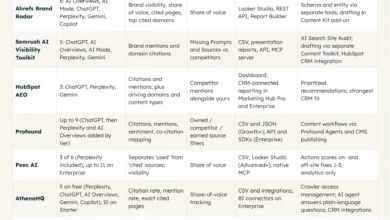
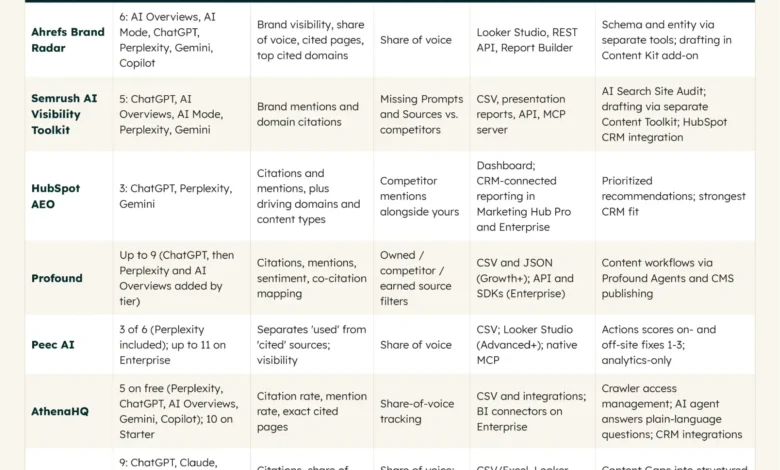
When selecting an AEO tool, organizations should prioritize several core capabilities. First is the scope of coverage: does the tool monitor ChatGPT, Perplexity, and Google AI Overviews? A platform that tracks only one engine provides a fragmented view of the brand’s presence.
Second is the depth of reporting. A tool should not only report whether a brand was mentioned but also provide the context. Was the brand cited as a primary source, a secondary source, or perhaps mentioned in a negative or incorrect light? This distinction is crucial for PR and brand management.
![AEO checker tools that measure answer engine visibility [2026]](https://53.fs1.hubspotusercontent-na1.net/hubfs/53/aeo-checker-3-20260903-8904553.webp)
Third is the integration with existing workflows. As seen in tools like HubSpot AEO, the most effective solutions connect these insights directly to content management systems. When a tool identifies that a competitor is being cited for a "best-of" query, it should ideally suggest a content update or a schema correction, allowing the marketing team to act immediately.
Data-Driven Metrics for the AI Era
Transitioning to an AEO-first mindset requires a shift in key performance indicators (KPIs). Traditional metrics like "click-through rate" are becoming less relevant as organic traffic from search engines declines. Instead, businesses must focus on:
- Citation Coverage: The percentage of relevant queries where the brand is explicitly cited.
- Brand Mention Frequency: How often the brand is named within an answer, even if a direct link is not provided.
- Competitor Share of Voice: The frequency with which rivals are cited for the same queries.
- AI-Referred Sessions: A measurement of the traffic that does successfully navigate from the AI citation to the website.
These metrics, when tracked over time, provide a clear picture of brand authority. A downward trend in citation coverage is a leading indicator that the brand’s content is losing relevance or failing to meet the standards of "trust" required by modern AI models.
![AEO checker tools that measure answer engine visibility [2026]](https://53.fs1.hubspotusercontent-na1.net/hubfs/53/aeo-checker-4-20260903-6212698.webp)
Implications and Strategic Adaptation
The rise of AI search has profound implications for digital strategy. Search engines now prioritize content that is highly structured, factually dense, and primary-source heavy. The "SEO vs. AEO" debate is largely a distraction; the two are symbiotic. Strong SEO—characterized by crawlability, technical health, and domain authority—is the foundation upon which AEO success is built. An AI engine cannot cite content it cannot reliably crawl or understand.
From a business perspective, the implications are two-fold. First, there is a risk of "information leakage," where the value of a brand’s intellectual property is consumed by an AI to answer a user’s question, leaving the brand with no traffic or lead generation. Second, there is a massive opportunity for brands that successfully optimize for AEO to become the "default" answer in their respective industries. By becoming the cited source, brands can establish an unparalleled level of trust with their audience.
The Future of Search Infrastructure
As the technology matures, we can expect AI models to move beyond simple citations toward more complex, multi-modal answers. This will likely involve the integration of proprietary datasets and real-time verification. Consequently, the tools used to monitor this space will also need to evolve. We are moving toward a future where AEO checkers will likely utilize machine learning to predict which content updates are most likely to result in a citation before they are even published.
![AEO checker tools that measure answer engine visibility [2026]](https://53.fs1.hubspotusercontent-na1.net/hubfs/53/aeo-checker-5-20260903-8938354.webp)
For enterprises and small businesses alike, the message is clear: the era of the passive website is ending. In the age of generative search, you are only as visible as the answers you provide. As the industry continues to integrate AI into every facet of the user journey, those who invest in sophisticated AEO monitoring and adaptation will secure a dominant position in the new search hierarchy. Whether through enterprise-grade tools like HubSpot or specialized trackers like Peec AI and AthenaHQ, the priority must be to bridge the gap between being a source of information and being the recognized authority in the eyes of the engine.
Ultimately, the goal of AEO is not just to be seen, but to be the source that the machine trusts. By systematically tracking visibility, refining content structure, and focusing on verifiable, high-quality data, brands can ensure that even in a world where users rarely click a link, their brand remains the primary answer.